Daily Weather Briefing
Saturday, November 14, 2026


ALABAMA THIS MORNING
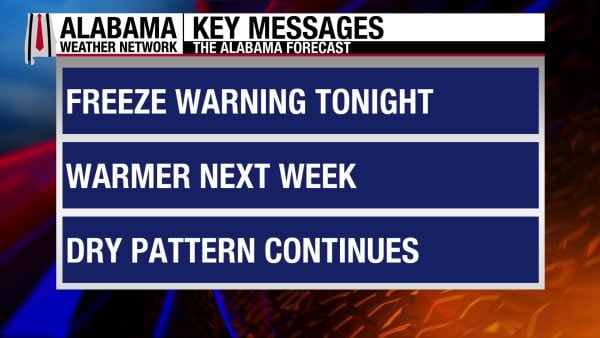
It’s a cold morning in Alabama with temperatures in the 30s across the state! A Freeze Warning is in effect for most of the state until 8 a.m., while a Frost Advisory is in effect for the south, also until 8 a.m. Our Regions Skycam in Cullman features the rising sun and cold temperatures!
ALABAMA 7 DAY FORECAST
This weekend will be dry and cold as a Continental Polar airmass sits over the East. As we head into next week, a low-pressure system will cut south of Alabama, bringing low chances for rain to the coast on Monday. Then upper-level ridging and a surface high-pressure system will allow temperatures to rise slowly next week.
COLD WEEKEND – Nov 14-15
As our Frost and Freeze Warnings begin to expire this morning, we can expect clear skies, wind gusts of up to 15 mph, and highs in the mid 50s north, and mid to upper 50s over the southern two-thirds of the state. Coastal Alabama will manage the low 60s.
Tomorrow morning will see another Freeze Warning for the northern two-thirds of the state and a Frost Advisory for the south as lows fall to the upper 20s north, low 30s centrally, and low to mid 30s south. The coast will stay in the low 40s. We’ll be cloudier on Sunday, and highs will be in the upper 50s north, and upper 50s to low 60s across central and south Alabama.
MOSTLY DRY MONDAY – Nov 16
A low-pressure system to our west will move southeastward and push south of Alabama Monday. This will bring a very low chance of a shower or two to the coast. Otherwise, Alabama will be dry, and lows will fall to the low 30s north, low to mid 30s centrally, and upper 30s to low 40s south. Highs will increase to the upper 50s to low 60s statewide.
WARMING NEXT WEEK – Nov 17-20
Alabama stays dry after Monday, and the big story through the end of next work week is the slow increase in lows and highs each day.
Tuesday will start off with lows in the low to mid 30s in the north, the upper 30s in central Alabama, and the upper 30s to mid 40s in the south. Then in the afternoon, highs will climb to the mid 60s statewide.
Wednesday morning will see temperatures range from the low 30s north to the mid 40s south, and highs will reach the upper 60s to low 70s across the state.
We’re expecting the upper 30s in the north and the upper 40s in the south on Thursday morning. We’ll really start to get back into those warm temperatures by Thursday afternoon as highs will easily hit the upper 60s north and low to mid 70s over the southern two-thirds of the state.
The end of the work week also brings the warmest temperatures of the week, with lows in the low 40s north to low 50s south. Then highs will range from the low 70s north to the mid 70s in the south.
RAINFALL OUTLOOK
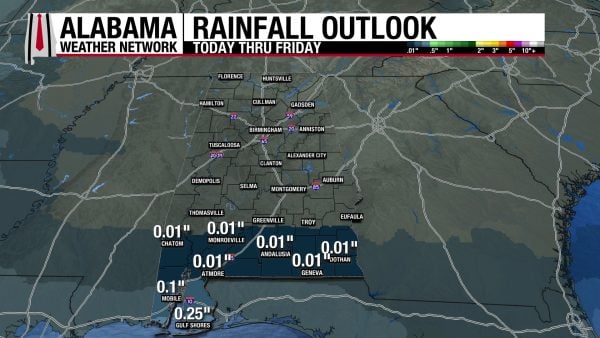
As the low passes south of Alabama Monday, the south could see a hundredth of an inch of rain, while coastal Alabama could see up to a quarter of an inch.

AUBURN VS. MISSISSIPPI STATE
Auburn is in Starkville to play Mississippi State at 11:00 a.m. CST. Expect a sunny sky with temperatures rising from near 48 degrees at kickoff into the mid 50s by the end of the game.

BAMA VS. VANDERBILT
Alabama is in Nashville to take on Vanderbilt at 11:45 a.m. CST. The sky will be sunny, and temperatures will rise from near 47 at kickoff into the low 50s by the final whistle.
HOME GAMES
The weather will be cool and dry for all of the other games across the Deep South.
THE ATLANTIC
The Atlantic will see no tropical activity over the next 7 days.
THE PACIFIC
The Pacific is finally quiet, with no tropical activity expected over the next 7 days.

COOL AND DRY ON COAST THIS WEEKEND
It will be a cool and dry weekend on the coast with highs in the low to mid 60s, sunny skies, and winds from the northeast at 10 mph. The rip current risk will be Low, and the surf height is around 1 foot both today and tomorrow. Then a low chance of a few showers is expected Monday and Tuesday.
TODAY IN WEATHER HISTORY
November 14, 1970 – Southern Airways Flight 932 Crash
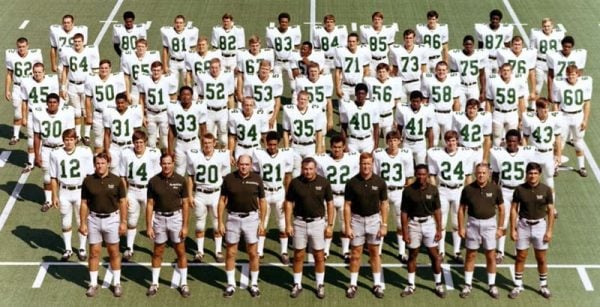
On the rainy evening of November 14, 1970, one of the darkest tragedies in American sports history unfolded in the hills of West Virginia. Southern Airways Flight 932, a chartered McDonnell Douglas DC-9, was carrying the Marshall University football team, coaches, university officials, and supporters home to Huntington after a 17–14 loss to East Carolina University earlier that afternoon. The aircraft departed Kinston, North Carolina, at 6:38 p.m., with 75 people aboard, including 37 football players, five coaches, and numerous prominent members of the Huntington community. The flight itself was routine until the aircraft approached Tri-State Airport, situated among the rugged hills southwest of Huntington. A cold, damp evening had settled over the region, with low clouds, mist, and light rain reducing visibility around the airport. Just minutes from landing, the passengers were anticipating their return home, unaware that the aircraft was descending toward a wooded hillside rather than the runway.
At approximately 7:23 p.m., the flight crew contacted air traffic control at Huntington and received clearance to conduct an instrument approach to Runway 11. Weather observations indicated a broken cloud ceiling near 500 feet, with additional clouds above, light rain, fog, and visibility of approximately five miles. Although these conditions were not exceptionally severe by aviation standards, the combination of low clouds, darkness, and mountainous terrain made an instrument approach particularly demanding. Unlike modern precision approaches that provide both horizontal and vertical guidance, the localizer approach available to the crew provided guidance toward the runway but required the pilots to manage their descent using instruments and published altitude restrictions. The aircraft was not permitted to descend below 1,240 feet above sea level until the pilots could visually identify the runway environment. Instead, Flight 932 continued descending below that minimum altitude. At approximately 7:36 p.m., the DC-9 struck trees on a hillside about one mile short of the runway. The aircraft crashed into the wooded slope and erupted in flames, killing all 75 people aboard.
The news devastated Huntington, a community where Marshall University football represented far more than a Saturday afternoon sporting event. Among the dead were players, coaches, athletic department officials, medical personnel, and loyal supporters who had traveled to North Carolina to cheer on the Thundering Herd. Head coach Rick Tolley was among those killed, along with university athletic director Charles Kautz and longtime sports information director Gene Morehouse, whose voice had become familiar to Marshall football fans through radio broadcasts. The loss reached into nearly every corner of the city. Families lost sons, husbands, fathers, and friends, while the university suddenly faced the unimaginable task of mourning much of its football program. Some players and coaches had not made the trip, and their survival would later become central to the effort to rebuild. Memorial services filled churches and public gathering places as Huntington struggled to comprehend the magnitude of its loss. The disaster became the deadliest aviation accident involving an American sports team, leaving a permanent mark on Marshall University and the surrounding community.
Investigators from the National Transportation Safety Board examined the wreckage, flight recordings, weather observations, and approach procedures to determine why an otherwise routine flight had ended so catastrophically. Their investigation concluded that the probable cause was the aircraft’s descent below the minimum permitted altitude during a nonprecision instrument approach without visual contact with the runway. Investigators could not establish precisely why the crew descended too low, identifying improper interpretation or use of cockpit instrument information and a possible altimetry system error as the two most likely explanations. Importantly, the investigation did not conclude that the weather alone caused the crash. Rather, the low clouds and reduced visibility created conditions in which strict adherence to instrument approach procedures was essential. The NTSB subsequently recommended greater emphasis on crew coordination during nonprecision approaches, improved navigation systems providing vertical guidance, and further evaluation of ground proximity warning equipment. These recommendations reflected broader efforts to prevent aircraft from unknowingly descending into terrain during otherwise controlled flight.
In the years that followed, the Marshall University football program became a symbol of resilience and remembrance. Rather than abandon football, the university committed to rebuilding its team under new head coach Jack Lengyel, relying heavily on freshmen, surviving players, and students willing to help restore the program. The emotional journey was brought to a wider audience through the 2006 film *We Are Marshall*, starring Matthew McConaughey as Lengyel. Each November, Marshall University holds a memorial ceremony honoring the 75 victims, gathering at the Memorial Student Center fountain, which serves as a permanent tribute to those lost. The fountain’s water is turned off during the annual ceremony and remains still through the winter months, a tradition symbolizing the enduring grief and remembrance of the university community. More than half a century after the crash, the tragedy remains a powerful intersection of aviation history, weather, and human loss. The legacy of Flight 932 endures not only in the lessons learned about aviation safety, but also in the extraordinary determination of a university and community that refused to allow its darkest night to define its future.

IMAGE OF THE DAY
Skywatcher Daniel Harbin took this wonderful photo of the sunset in Trenton last night!