The “jet stream” has been discussed for years as an important aspect of the weather, especially in mid-latitudes (like the contiguous U.S.). The jet stream is best described as the dividing zone between cold air to the north and warm air to the south.
Some meteorology. Colder air is more dense than warm air, so the pressure drops much more quickly with height in cold air than in warm air. This is why thickness between two pressure layers is an important factor in determining snow vs. rain in the winter…it indicates the average temperature in the layer. One does not have to go as high in the atmosphere to get to the 500 mb pressure level in cold air as they do in warm air. Below is a chart of the thickness between 1000 mb (low-level) and 500 mb (mid-level) pressure layers, with 1 pm observed temps thrown in at a few places.

Now, compare that map to the map showing contours of the height of the 500 mb surface. They look similar. The low-level pressure just doesn’t seem to change as much, in general, as it does aloft. So, higher temperature often means higher pressures aloft.
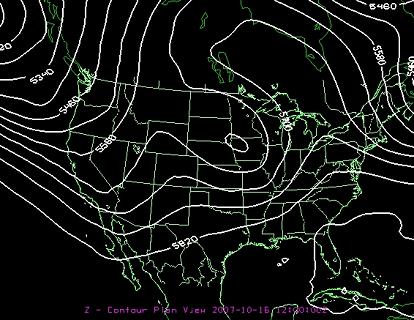
Since the wind speed is well-approximated by the gradient in the pressure field, ie., how much it changes over distance, the wind will be highest where the pressure gradient is highest. Since pressure aloft is related to the warmth of the air below it, areas of large temperature gradients (like cold fronts) often mean high winds aloft. This is why the jet stream often separates warm air from cool air.
NCEP has gone back and analyzed detailed weather maps, using the data of the time and new technology, which allows us to show how, on average, the jet stream moves south, along with the temperature gradient separating warm air from cold air, during the autumn. Below is the average east-west 300 mb wind speed for a 25-30 year period, starting in August and going through late November. Notice how the jet stream strengthens and moves south.

(NCEP/NCAR Reanalaysis)