THE COLDEST, HOTTEST, AND WETTEST SUPER BOWLS
…and a look at today’s forecast in Santa Clara
The Super Bowl has been played in everything from desert heat to driving rain to bone-chilling Arctic air. While the NFL usually chooses warm-weather or indoor sites to avoid weather drama, Mother Nature has still managed to leave her mark on football’s biggest stage.
As we head into today’s Super Bowl in Santa Clara, California, the weather story is about as calm as it gets—something the NFL loves.
TODAY’S FORECAST: SUPER BOWL LX, SANTA CLARA, CALIFORNIA
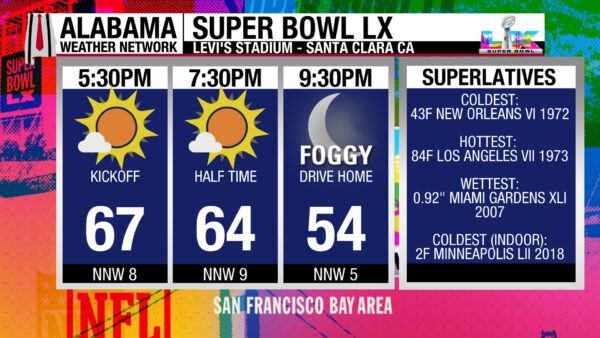
Conditions for the game at Levi’s Stadium are expected to be mild and dry, with temperatures in the mid-60s around kickoff and falling into the low-50s by the end of the game.
Winds should be light, generally 5–10 mph or less, and rain chances are minimal or near zero during the game window.
In short, the Bay Area is delivering classic Super Bowl weather: comfortable temperatures, no significant wind, and little threat of precipitation—ideal conditions for an outdoor championship game.
THE COLDEST SUPER BOWL SUNDAY
The coldest conditions ever associated with a Super Bowl came on February 4, 2018, in Minneapolis during Super Bowl LII. The game itself was played indoors at U.S. Bank Stadium, but outside temperatures at kickoff were just 2 degrees above zero. Wind chills dipped well below zero across the Twin Cities as fans made their way into the stadium.
Inside, the conditions were comfortable, but outside it felt more like midwinter on the northern Plains. The Philadelphia Eagles defeated the New England Patriots 41–33 in one of the most memorable Super Bowls ever.
The coldest Super Bowl actually played outdoors came decades earlier. On January 16, 1972, Super Bowl VI was held at Tulane Stadium in New Orleans. The high temperature only reached 43 degrees, far below the city’s typical mid-60s for January. Fans bundled up in coats as the Dallas Cowboys defeated the Miami Dolphins 24–3.
THE HOTTEST SUPER BOWL
On the opposite end of the spectrum, the hottest Super Bowl on record took place on January 14, 1973, at the Los Angeles Memorial Coliseum. The kickoff temperature soared to 84 degrees, the warmest ever recorded for the big game.
The Miami Dolphins defeated Washington 14–7 that day, completing the only undefeated season in NFL history. It remains both a football milestone and a meteorological one.
More recently, warm conditions returned during Super Bowl LVI on February 13, 2022, at SoFi Stadium in Inglewood, California. The kickoff temperature reached 82 degrees, making it one of the warmest Super Bowls on record.
THE WETTEST SUPER BOWL
Rain is rare on Super Bowl Sunday, especially in South Florida, where February is typically part of the dry season. But on February 4, 2007, that reputation didn’t hold.
Super Bowl XLI in Miami Gardens became the wettest Super Bowl in history, with nearly one inch of rain falling during the game. Winds gusted to around 20 mph, and the slick field contributed to a sloppy contest that featured eight turnovers, including five lost fumbles.
The Indianapolis Colts defeated the Chicago Bears 29–17, and the image of Peyton Manning hoisting the Lombardi Trophy in the rain remains one of the most unusual scenes in Super Bowl history.
WHEN WEATHER ALMOST STOLE THE SHOW
The NFL’s gamble on a cold-weather outdoor Super Bowl nearly backfired on February 2, 2014, when Super Bowl XLVIII was played at MetLife Stadium in New Jersey. The game itself featured relatively mild conditions, with a high of 55 degrees and a kickoff temperature of 49.
But winter reminded everyone who was in charge—eight inches of snow fell in the Meadowlands the very next day, which could have caused major travel and logistics problems had it arrived 24 hours earlier.
THE BOTTOM LINE
From 84-degree heat in Southern California to rain-soaked turf in Miami and near-zero temperatures in Minnesota, Super Bowl weather has covered nearly the entire meteorological spectrum.
And today in Santa Clara, the atmosphere is cooperating perfectly—mild, dry, and comfortable—just the way the NFL drew it up.