“We Prayed” — The Night an F4 Tornado Changed Fort Payne Forever
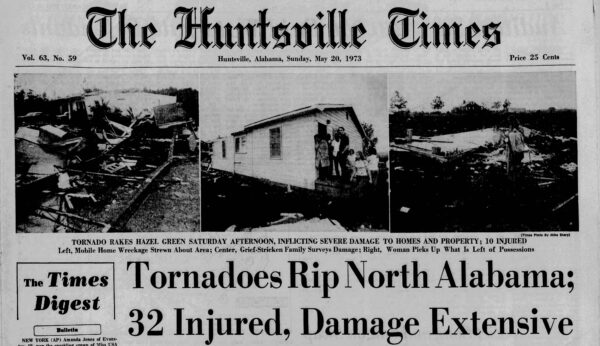
By the evening of May 19, 1973, the people of Fort Payne, Alabama had already watched storms rage across northeast Alabama for hours.
Large hail pounded homes and businesses. Tornadoes had already struck parts of Madison, Jackson, and DeKalb Counties earlier in the afternoon. But in Fort Payne, many residents still did not fully understand what was about to happen.
Then the sky changed.
Witnesses later remembered an eerie stillness settling over town. Some described the sky turning “black as night.” Others recalled an almost unnatural calm before the storm arrived. One resident on Lookout Mountain said the tornado looked “like a huge tire on fire, smoke boiling” as it crossed the ridge toward Fort Payne.
Moments later, the city heard the sound.
It sounded just like a train.
That freight-train roar became the soundtrack of one of the most terrifying nights in Fort Payne history.
The Beauty Pageant
At Williams Avenue School, around 150 people had gathered for the Jaycette’s Little Miss Maid of Cotton beauty pageant. Parents sat watching their daughters participate while organizers worked backstage preparing contestants.
Outside, the tornado was already approaching.
One eyewitness recalled a man suddenly rushing into the gymnasium screaming for everyone to get against the walls and down on the floor. There were only seconds to react.
Then the tornado hit.
The gymnasium shook violently. Part of the roof was torn away. Windows shattered as debris slammed into the building. Parents threw themselves over children. Contestants cried and screamed while adults prayed.
And somehow — remarkably — no one inside the gymnasium was seriously injured.
The Tornado Enters Fort Payne
At approximately 6:55 p.m., the tornado tore into the northern part of Fort Payne.
The storm would later receive an F4 rating.
Damage surveys showed the tornado carved a 5.4-mile path across the city and toward Lookout Mountain with a width approaching 400 yards. At least 37 buildings were destroyed and another 117 structures were damaged.
Homes were ripped apart. Roofs disappeared. Entire walls collapsed.
Some houses were reportedly lifted off their foundations and twisted before being dropped back down. Near Jack’s restaurant, residents said apartment buildings were shifted into the street.
One destroyed car dealership scattered paperwork so high into the storm that documents were reportedly found in Georgia weeks later.
The Hospital District
Some of the most dramatic moments occurred near the old Fort Payne hospital.
People inside the emergency room later described men physically holding the double doors shut against the tornado’s pressure. Cars and trucks were reportedly lifted and tossed outside. Witnesses remembered power lines whipping through the air “sizzling like a dynamite fuse.”
One woman watching from the hospital described seeing the tornado move directly toward the building before suddenly turning toward Lookout Mountain.
Across the street, a church was destroyed. Witnesses described watching the structure slowly expand outward before collapsing completely.
Inside the darkened hospital hallways afterward, doctors reportedly walked room to room using flashlights while injured victims arrived from across the city.
Lookout Mountain
As the tornado climbed toward Lookout Mountain, destruction continued.
Homes suffered catastrophic damage. Trees snapped. Roofing material and lumber were carried long distances.
One resident later recalled watching a walnut tree simply disappear into the storm. Another family said the tornado lifted their home from its foundation before slamming it back down.
A witness near Beason Gap described seeing multiple funnels descending from the storm at once. Others remembered seeing debris spinning thousands of feet in the air.
“We Prayed”
Officially, 19 people were injured in the Fort Payne tornado.
Across northeast Alabama, dozens more injuries occurred as multiple tornadoes swept through the region during the afternoon and evening. Yet many residents believed the death toll could have been far worse.
In the aftermath, the Fort Payne Times-Journal captured the emotions of the city with a now-famous headline:
“We Prayed.”
The words reflected exactly what many families had experienced that night.
People prayed under kitchen tables. Parents covered children with their bodies. Hospital workers braced doors shut while debris exploded outside. Neighbors searched through wreckage in darkness illuminated only by flashlights and emergency vehicles.
The Red Cross distributed food and supplies through the night while firefighters, police officers, rescue squads, and volunteers worked street by street across the devastated community.
The tornado became one of the defining disasters in Fort Payne history.
Even decades later, survivors still vividly remembered the black sky, the strange silence, the roar of the tornado, and the terrifying realization that their world was being torn apart in front of them.
For Fort Payne, May 19, 1973 was more than just another severe weather event.
It was the night the city prayed together and survived.