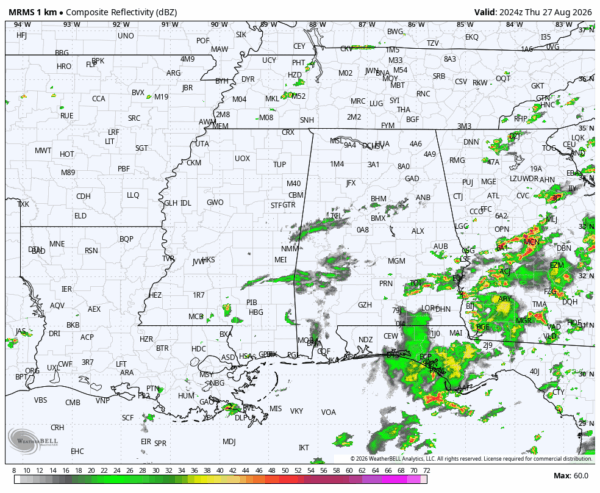
RADAR CHECK: We have a few scattered storms across parts of Southeast Alabama this afternoon in a broad zone from Luverne to Eufaula, and some patchy light rain over the southwest part of the state. Otherwise we have more clouds than sun with temperatures only in the 80s in most spots. Scattered storms end tonight after sunset.
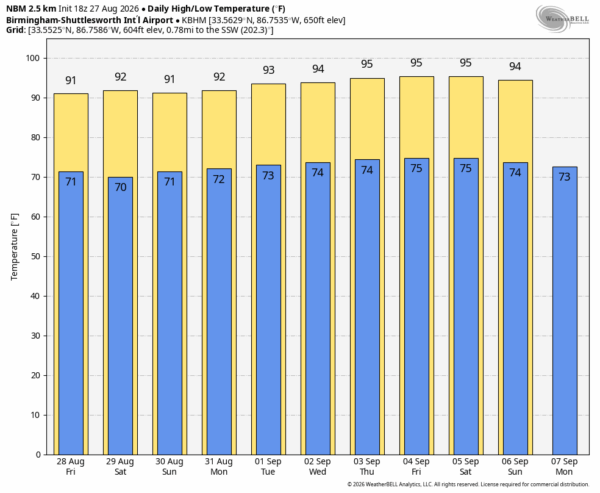
TOMORROW AND THE WEEKEND: Fairly routine late August weather is the story, but the trend will be toward fewer scattered showers and storms as an upper ridge begins to build in from the west. Best chance of an afternoon shower or thunderstorm will be over the southern half of the state, and afternoon highs will be in the low 90s. Showers will be fewer in number over the weekend.
NEXT WEEK: The ridge strengthens, and heat levels slowly rise, with afternoon highs reaching the mid 90s over the latter half of the week. Afternoon showers or storms are possible, but they should be widely spaced thanks to the ridge. See the video briefing for maps, graphics, and more details.
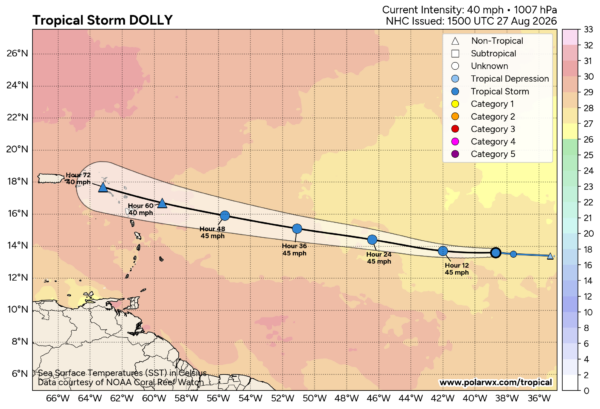
TROPICS: NHC upgraded “Invest 96L” to Tropical Storm Dolly this morning. The system is weak and not especially organized; sustained winds are estimated to be only 40 mph. Dolly is about 1500 miles east of the Leeward Islands, and is moving to the west at 24 mph. The environment around Dolly should become unfavorable for strengthening by tomorrow with increasing southwesterly shear due to a central Atlantic upper-level trough, fast forward motion and dry air aloft.
Dolly will weaken into an open wave by the weekend, and the rest of the Atlantic basin is quiet. Tropical storm formation is not expected across the Gulf for at least the next 7-10 days.
LUNAR ECLIPSE TONIGHT: Alabama will get a spectacular deep partial lunar eclipse tonight. The eclipse begins subtly around 8:23p CT, but the really noticeable partial eclipse begins at 9:33p CT. The peak comes a little before 11:15p CT, when about 96% of the Moon will be covered by Earth’s dark shadow. The Moon will take on a dramatic reddish-orange color. No special glasses are needed—just hope for breaks in the clouds!
ON THIS DATE IN 1883: Krakatoa Volcano exploded in the East Indies. The explosion was heard more than 2500 miles away, and every barograph around the world recorded the passage of the airwave, up to seven times. Giant waves, 125 feet high and traveling 300 mph, devastated everything in their path, hurling ashore coral blocks weighing up to 900 tons, and killing more than 36,000 persons.
Volcanic ash was carried around the globe in thirteen days producing blue and green suns in the tropics, and vivid red sunsets in higher latitudes. The temperature of the earth was lowered one degree for the next two years, finally recovering to normal by 1888.
Look for the next video briefing here by 6:00 a.m. tomorrow…