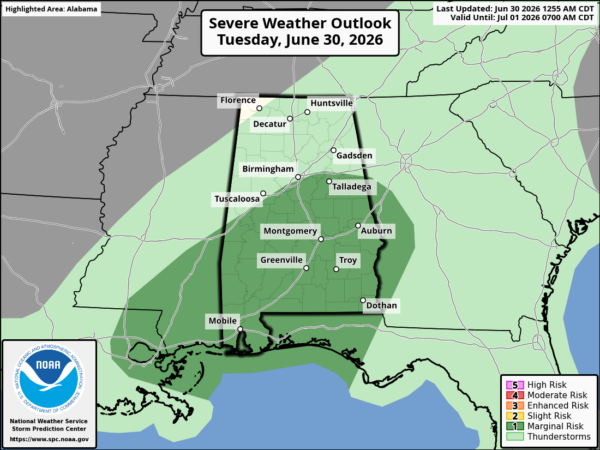
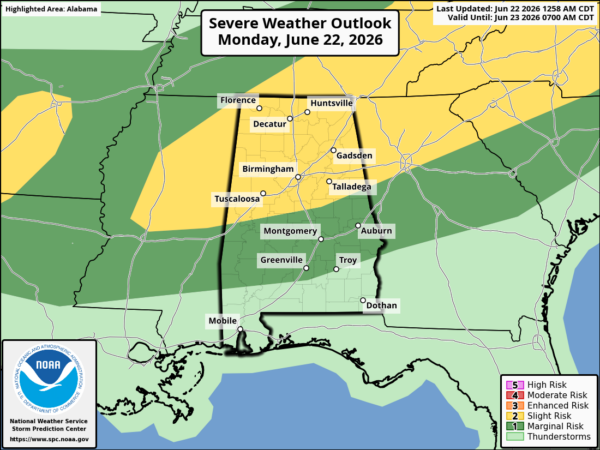
First of all, it is always difficult to find out that someone passed away in a storm, as occurred last night in Leeds. As a meteorologist, it somehow makes it more difficult that it was weather-related.
There has been a lot of talk about last night’s event. The National Weather Service issued a severe thunderstorm warning for all of Jefferson county at 323 am, then issued a tornado warning for a small part of southern Jefferson county at 328 am. The tornado warning was cancelled at 343 am, 15 minutes later, but the severe thunderstorm warning continued until 400 am. While it appears that there was no tornado in that small part of Jefferson County, the sirens went off over the entire county, as did NOAA Weather Radios. This sent many to their safe place, which, in an event with wind gusts over 70 mph, is a good thing no matter if the winds are from a tornado or in a straight-line. There may have been a small tornado somewhere in Jefferson County last night…survey teams from the NWS are out checking the damage right now.
This event reminds me of the high wind event around 430 am on March 29, 1991, 5 days before I started working at the NWS. Hundreds of trees were down as I recall, including significant damage at Birmingham Country Club in Mountain Brook. If I remember correctly, many were angry that there was no tornado warning and no sirens. The fact is, that event was not a tornado, as confirmed by storm surveys. But, with widespread winds of 70 mph, should the sirens have gone off? A similar event occurred on February 16, 2001, when winds gusted as high as 99 mph in Jefferson County, and damage was extensive. The sirens went off in that event, but probably only because a tornado warning was in effect for one part of the large squall line that caused the wind.
The debate has been discussed in many ways. How do we handle events like last night? A severe thunderstorm with 70 mph winds can cause tremendous damage, and can cause injuries and even fatalities. But do we sound the sirens for all severe thunderstorm warnings? All that is required for a “severe thunderstorm” is one location receiving a wind greater than 58 mph, or hail the size of dimes or larger. Imagine how many times this occurs each summer.
There have been committees formed to discuss changing the criteria for severe thunderstorms, and some counties sound the sirens for severe thunderstorm warnings also.
I am posing some of these questions to see what you think.
However, events like this show the importance of everyone having a NOAA Weather Radio in their home. Their alert sounds for any kind of severe weather warning, making the entire argument not matter.
A more thorough scientific analysis of what happened will be posted later, once level-II NEXRAD data is available.