June 21
Sep 22
With the days getting shorter and the sun getting lower in the sky, the northern hemisphere is starting to cool down, and that cool air eventually starts to come south, as large temperature differences from north to south are not stable conditions. Some models have been hinting at a significant cold front next week, others hold the cold air back in the Plains. We’ll see.
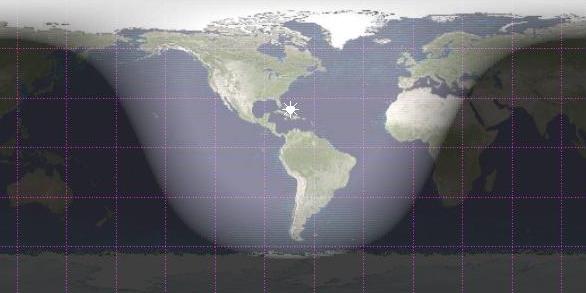
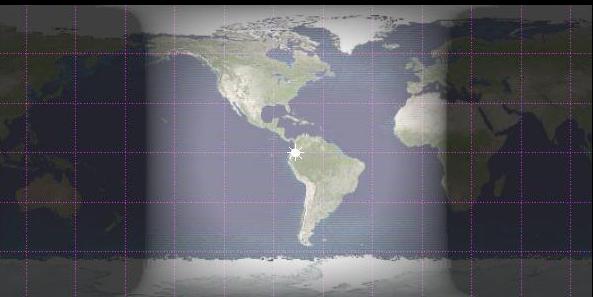
Before we get into the cool air on the way next week, let’s talk about the “official” start to fall, the equinox, that occurs next Tuesday afternoon at 2118 GMT (418 pm CDT). At that time, the earth’s will be in a position in its yearly orbit around the sun when the northern hemisphere and southern hemisphere get equal sunlight. Above is the “geochron”-style view of the earth’s lighted areas at noon CDT on June 21 and next Tuesday, September 22.
Notice how there was a lot more sunlight was in the northern hemisphere on June 21, and days were longer than in the southern hemisphere. But, on Sep 22, daylight will be even across the globe, and every location will have about 12 hours of daylight (actually about 12 hrs, 7 minutes due to refraction of light). We got the maximum sunlight on the first day of summer in June, and the days have been getting shorter ever since, but not much.
Using math developed a long time ago (published in 1948 in the meteorological journals), here are charts of the sunrise and sunset at Birmingham for the year, based on our position in the time zone (east of the middle, so we get earlier sunrises and sunsets than Texas).
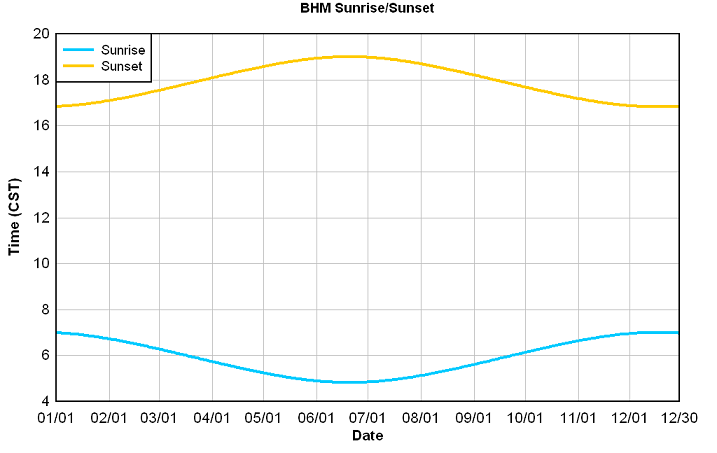
The earliest sunrise and latest sunset occur on June 21, with the latest sunrise and earliest sunset occurring on Dec 21 (these times are in CST, actually in the summer both times are an hour later, our latest sunset is 8:01 pm (2001) CDT)

This chart shows the length of daylight (in hours) over the year. We vary from about 9 hours, 45 minutes on December 21 to 14 hours, 15 minutes on June 21. The dashed line indicates that the change in length of daylight per day. Notice it is negative 2 minutes per day now, so we are losing 2 minutes per day of sunlight, and that right now is the most rapid loss of daylight in the whole year. For math people out there, the length of day is a sine wave, and the change is the derivative dDaylight/dt, and the derivative of sine is cosine, as shown here.