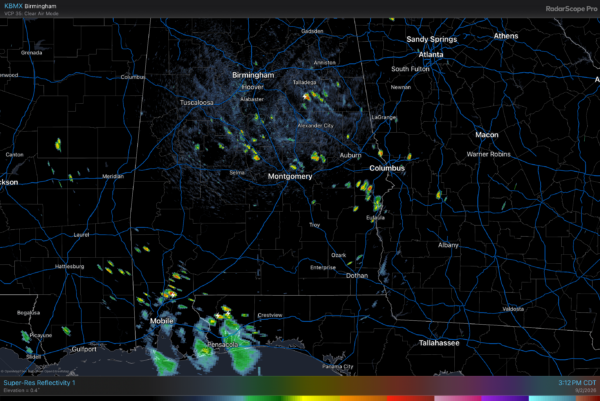
THE HEAT IS ON: Temperatures are generally in the mid to upper 90s across Alabama this afternoon with a partly to mostly sunny sky. There are a few small, isolated showers over the southern 2/3 of the state moving westward… they will fade quickly after sunset.
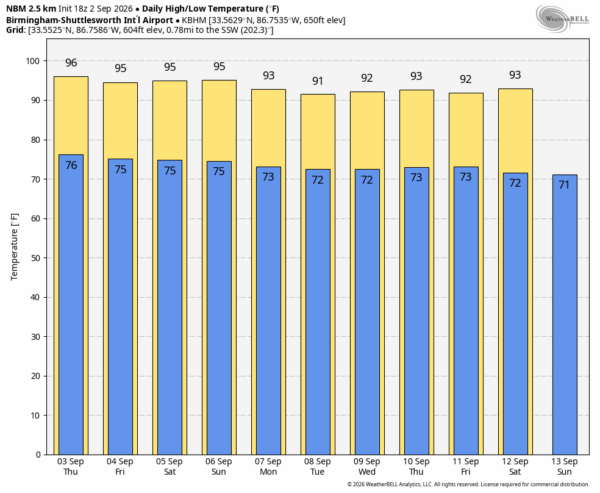
A strong upper high will remain parked over the region, meaning above average temperatures through the Labor Day weekend. Afternoon highs will remain generally in the mid to upper 90s, with daily heat index values over 100. Each afternoon a few showers and storms will pop up, but they will be very isolated, and mainly over the southern half of the state.
Heat levels will be slight lower next week, but still elevated with afternoon highs mostly in the low 90s. See the video briefing for maps, graphics, and more details.
FOOTBALL WEATHER: We are projecting temperatures in the 96-99 degree range in Tuscaloosa Saturday by the fourth quarter of the Bama/ECU game at Bryant-Denny Stadium (kickoff at 11a CT). The heat index will be in the 105-110 degree range.
Jacksonville State, South Alabama, Troy, Alabama State, and Alabama A&M all have Saturday home games, but they are all evening games with temperatures falling through the 80s.
Auburn plays in Mercedes-Benz Stadium Saturday against Baylor (2:30p CT kickoff).. it will be a pleasant 72 degrees in the climate controlled dome.
UAB will take on Illinois in Champaign tomorrow night (8p CT kickoff)… the sky will be clear with temperatures falling the low 80s at kickoff into the upper 70s by the second half.
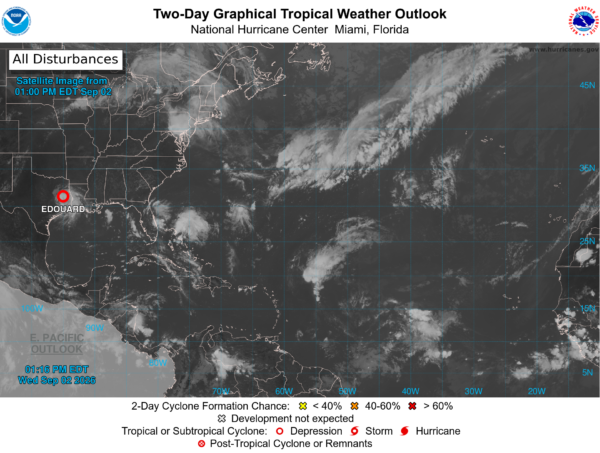
TROPICS: The Atlantic basin is unusually calm for early September and tropical storm formation is not expected through the next seven days.
ON THIS DATE IN 1935: One of the most powerful hurricanes in U.S. history slammed into the Florida Keys. The compact Category 5 storm had an estimated maximum sustained wind of 185 mph and a central pressure of 892 millibars—still the lowest pressure ever recorded at a U.S. hurricane landfall.
The hurricane caused catastrophic damage in the upper Florida Keys, as a storm surge of approximately 18 to 20 feet (5.5 to 6.1 m) swept over the low-lying islands. The hurricane’s strong winds and the surge destroyed nearly all the structures between Tavernier and Marathon. The town of Islamorada was obliterated. Portions of the Key West Extension of the Florida East Coast Railway were severely damaged or destroyed. In addition, many veterans died in work camps created for the construction of the Overseas Highway, in part due to poor working conditions. The hurricane also caused more damage in northwest Florida, Georgia, and the Carolinas.
Look for the next video briefing here by 6:00 a.m. tomorrow…