First of all, we must not forget the human tragedy that has occurred in Japan. However, there is a lot of science to be examined, not only with the earthquake, but also with the tsunami.
(USGS)
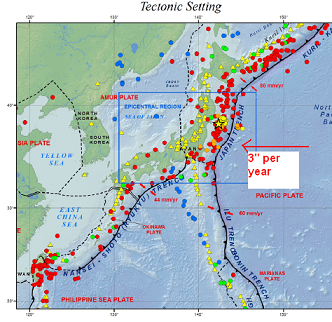
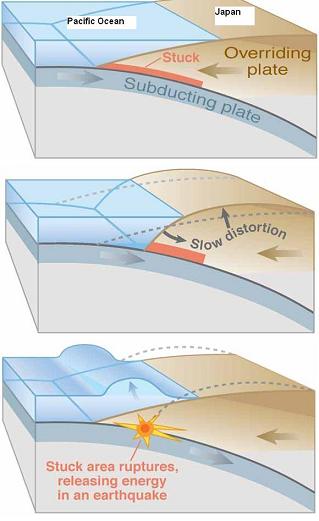
In summary, a magnitude 8.9 earthquake hit just off the coast of Honshu, Japan at 0546 UTC on Friday (11:46 pm CST). The earthquake was associated with a “subduction zone”, in this case where the Pacific plate of the Earth’s crust is slowly sliding underneath the plate where Japan is, at about 3″ per year. Sometimes, a certain region along the zone will get stuck together, with the plate where Japan is getting squeezed downward under the ocean (off the coast), and the land behind it (Japan) getting raised up a little. The two plates can be stuck in a certain region for decades or more, allowing a lot of stress to build up. Eventually, the earth can’t withstand the pressure, and the plate on top comes loose from the plate on the bottom and moves quickly out to sea and downward (see graphs below).
(Adapted from USGS)
This is basically what occurred in Japan on Friday. GPS indicates that the coast of Japan moved eastward an average 8 feet, while the tectonic plates moved over 50 feet total. Because of this, Japan is a little wider than it was before. Even places in the U.S., including in Alabama, moved up and down a little bit, too little to notice, and were displaced about 1/4” sideways. We may not have felt it, but seismographs around the world, including in the southeastern U.S., measured the ground movement here due to the earthquake centered in Japan.
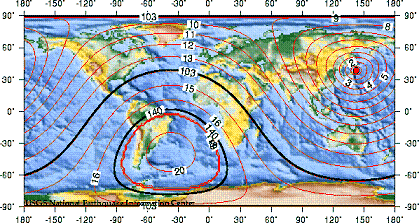
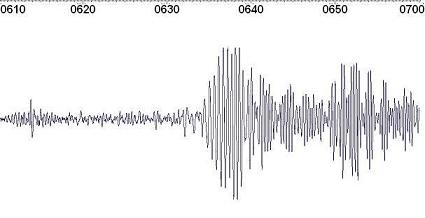
The map below shows the the theoretical movement of the P-wave, or the initial, fast-moving compression wave (similar to a sound wave) across the earth’s crust. It would have theoretically arrived in Alabama around 0600 UTC, or 1200 am Friday. However, due to processes in the earth’s core, the P-wave from an earthquake that far away has a hard time reaching that far away. The surface waves (like water waves in rock) move slower, and disperse, some moving slower than others. They arrived in Alabama as early as 0620 UTC (1220 am), and lasted for a while. They were detected very well by the seismogram at Tellus Museum in Cartersville, Georgia (see seismogram below, times are in UTC).
(USGS)
(Tellus museum)