The updated 2011 Atlantic hurricane season forecast from Dr. William Gray and Dr. Phil Klotzbach is out, and they expect a very active season. Hurricane season begins on June 1st, but the peak of activity is usually in the late summer (August and September).
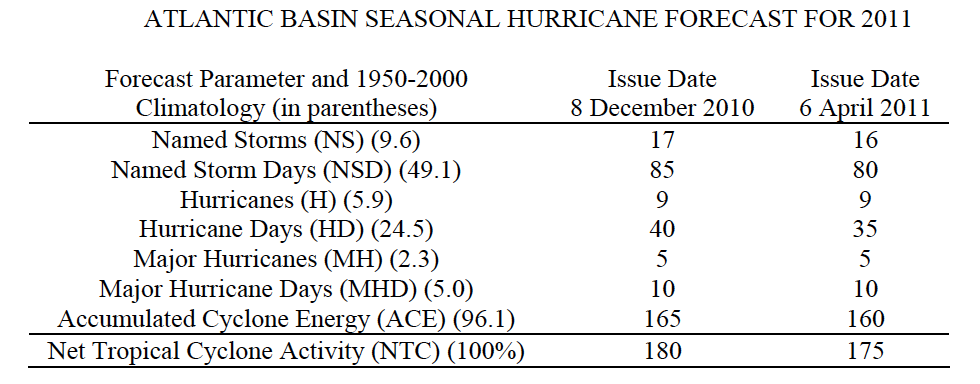
(Read the Entire Publication Here)
The “Abstract” from Today’s Forecast:
Information obtained through March 2011 indicates that the 2011 Atlantic hurricane season will have significantly more activity than the average 1950-2000 season. We estimate that 2011 will have about 9 hurricanes (average is 5.9), 16 named storms (average is 9.6), 80 named storm days (average is 49.1), 35 hurricane days (average is 24.5), 5 major (Category 3-4-5) hurricanes (average is 2.3) and 10 major hurricane days (average is 5.0). The probability of U.S. major hurricane landfall is estimated to be about 140 percent of the long-period average. We expect Atlantic basin Net Tropical Cyclone (NTC) activity in 2011 to be approximately 175 percent of the long-term average. We have decreased our seasonal forecast slightly from early December, due to anomalous warming in the eastern and central tropical Pacific and cooling in the tropical Atlantic.
This forecast is based on a new extended-range early April statistical prediction scheme that utilizes 29 years of past data. Analog predictors are also utilized. We expect current La Niña conditions to transition to near-neutral conditions during the heart of the hurricane season. Overall, conditions remain conducive for a very active hurricane season.
Gray and Klotzbach suggest that there is a higher-than-normal probability of a landfalling hurricane along the Gulf Coast this year:
PROBABILITIES FOR AT LEAST ONE MAJOR (CATEGORY 3-4-5) HURRICANE LANDFALL ON EACH OF THE FOLLOWING COASTAL AREAS:
1) Entire U.S. coastline – 72% (average for last century is 52%)
2) U.S. East Coast Including Peninsula Florida – 48% (average for last century is 31%)
3) Gulf Coast from the Florida Panhandle westward to Brownsville – 47% (average for last century is 30%)PROBABILITY FOR AT LEAST ONE MAJOR (CATEGORY 3-4-5) HURRICANE TRACKING INTO THE CARIBBEAN (10-20°N, 60-88°W)
1) 61% (average for last century is 42%)
The authors of the forecast state that they aware that a seasonal forecast in April is not going to be extremely precise, but it is a general guideline based on global-scale features to attempt to predict the nature of the coming season. There is some degree of accuracy in a seasonal forecast, but perception is everything! If the season ends up with 16 named storms and exactly five major hurricanes yet not a single storm impacts the United States, were they correct? I believe the answer is yes! Remember, the forecast is for activity in the entire Atlantic Basin; it is easier to predict the over-all activity than to predict small areas where landfall is most likely.
-Jason
Follow me on Twitter: @simpson3340