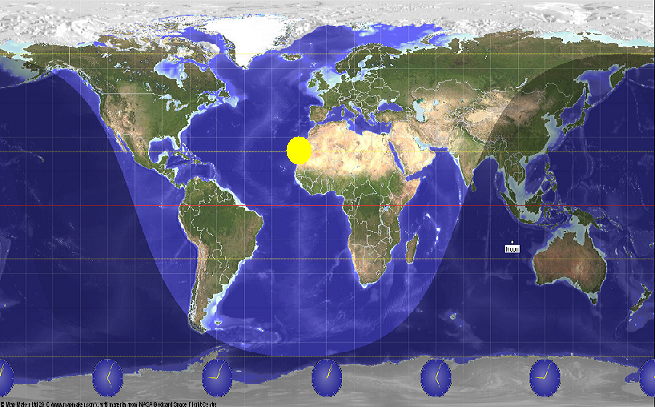
Summer “officially” started with the solstice at 1128 GMT (6:28 AM CDT) this morning. The above geochron-style image (y’all know I like these; they are often seen in Tom Clancy movies, CIA, etc.) shows where the sun is directly overhead (at the tropic) and the parts of earth in daylight at 6:28 am. Notice how most of the daylight is in the northern Hemisphere. Everywhere inside the Arctic Circle will have 24 hours of daylight today.
Today is the longest day of the year here. Sunrise occurred at 5:38 am, the sun will be directly overhead at 12:49 pm, and sunset tonight is at 8:00 pm, so we’ll have 14 hours and 22 minutes of daylight. Including twilight, it’s 15 hours and 20 minutes (twilight is longer now, and this is explained below). Compare today’s sun with December 21, when sunset was at 4:43 pm, only 9 hours 55 minutes of sunlight.
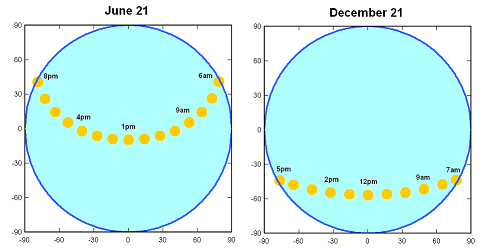
I mentioned twilight. The tilt of the earth causes the sun to take a different path across the sky in June than in December. The sun actually rises in the NE and sets in the NW in summer, making a much longer trajectory near the horizon, setting almost sideways. So, twilight (caused by light refracting in the sky from over the horizon) lasts longer in summer than in winter.
The sun angle is also highest in the sky today, meaning the amount of energy on a given area is the highest today (it is not spread out much over the ground). We will get 11.9 kWh/square meter of sun energy today, compared with 4.8 kWh/m2 on December 21 (about 2.5 times more sun today than winter).
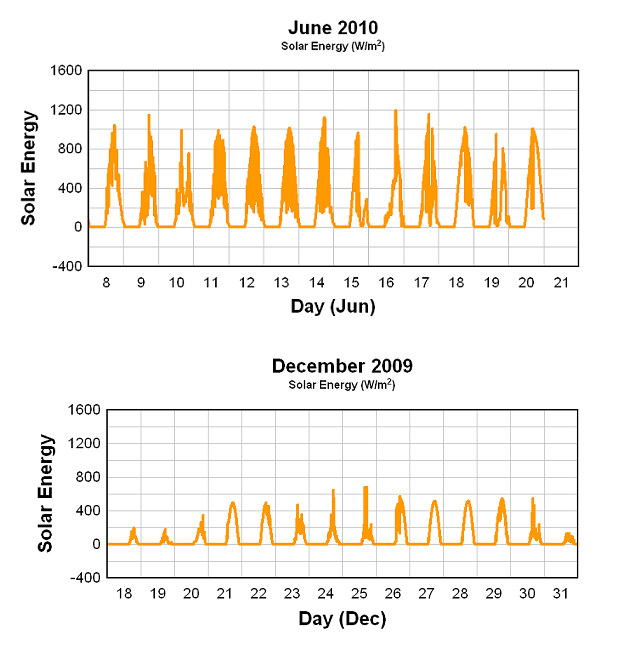
At UAH, we have an instrument known as a pyranometer, that measures incoming solar radiation every 5 seconds. Below, I have plotted that data for the past 2 weeks, and for the final 2 weeks in December 2009. Big difference. The days are longer now, and the light is more intense. Notice the very rough data in June. This is caused by clouds moving over the building. Right now, we’re getting up to 1,200 W/m2 at mid-day. In December, it was only 700 on the sunniest day, Christmas (of course!). However, some winter days never got above 200 W/m2, due to clouds all day.
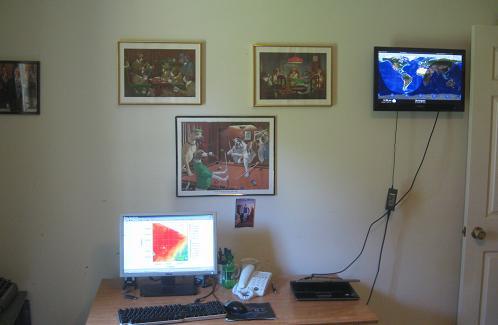
All of you know how much I like the Geochron…I’ve been talking about it on this blog for 3 years. A real one costs $1,500 to $2,000 (or more), not in the budget of a researcher. But, my smart wife got me some geochron software and a monitor for Christmas, so I now have a $300 Geochron on the wall in my office! Thanks, Jenny! I just need to get some wiremold and cover those wires, and I’ll look like I work for Jack Ryan, too.